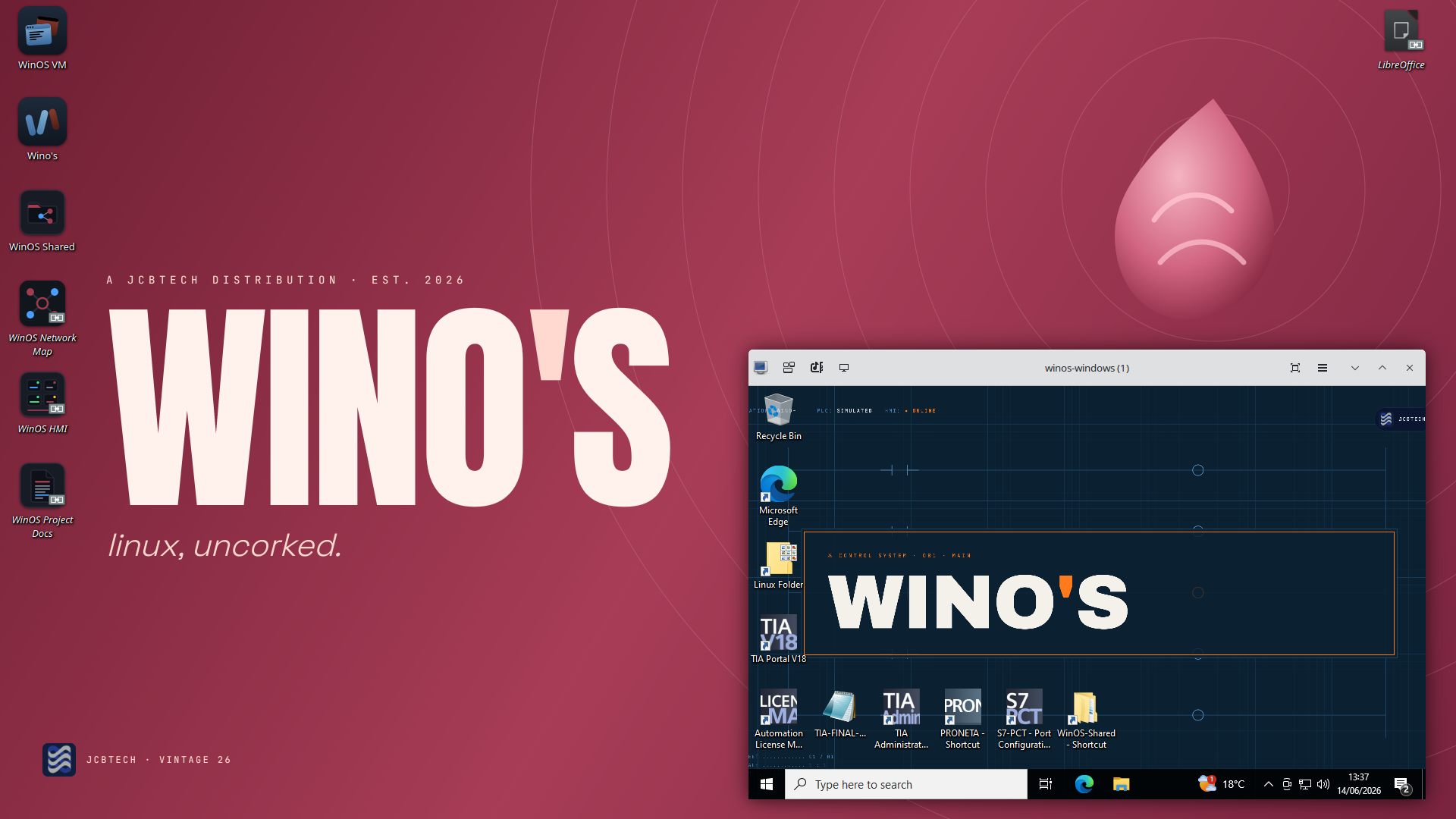
Case Study — Wino's: AI-Native Engineering OS
Wino's is a purpose-built Linux operating system that places a locally-run language model in direct command of industrial engineering software. It bridges a native Linux AI environment to Siemens TIA Portal, letting an engineer drive PLC programming and project work through natural language — entirely on-premises, with no proprietary data leaving the machine.
- Architecture. A local LLM on Linux communicates with TIA Portal running in a virtualised Windows environment, through a purpose-built bridge service exposing engineering functions as structured tools.
- TIA Openness integration. Deep integration with the Siemens TIA Openness API gives the assistant programmatic control of projects — creating, reading, importing and compiling program blocks under instruction.
- Closed-loop programming. The assistant writes control logic in SCL, compiles it, reads the compiler feedback, and iterates on its own errors — the same refine-until-correct cycle an engineer follows in the editor.
- Version-aware. Designed to operate across multiple TIA Portal versions, switching engineering environments on demand while presenting a single, consistent toolset.
- Secure by design. Local-first execution keeps source code, project data and intellectual property entirely within the engineer's own infrastructure.
Wino's reframes the engineering workstation: instead of an operator navigating menus, an assistant carries out high-level intent — from scaffolding a new project to diagnosing a block — while the engineer stays in control of every step.